Blog
From AI Copilots to Autonomous Agents: How Enterprise Software Is Evolving

October 29, 2026

time
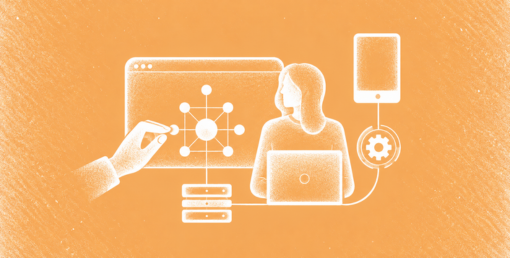
Enterprise software has traditionally been built around people. Employees open applications, search for information, review reports, enter data, and move tasks through established workflows. Even when software automates certain activities, people are usually responsible for deciding what happens next.
AI is beginning to change this model.
AI copilots can help employees write documents, analyze information, generate code, and find answers without switching between multiple tools. The next stage is the development of AI agents that can plan tasks, use business applications, and execute multiple steps toward a defined objective.
This shift is changing how companies think about productivity and automation. Instead of simply helping employees complete individual tasks, software can increasingly take responsibility for parts of an entire business process.
However, the transition from copilots to autonomous systems is not as simple as giving an AI model access to company applications. Businesses need reliable integrations, clear permissions, safeguards, and ways to monitor what these systems do.
Understanding the differences between copilots and enterprise AI agents is an important first step for organizations planning their next stage of AI adoption.
AI copilots and AI agents can use similar underlying models, but they differ in how they interact with business workflows.
An AI copilot primarily assists a person. It responds to questions, generates content, summarizes information, and suggests actions. The employee generally decides what to do with the output.
An AI agent can go further. Depending on its configuration and permissions, it can interpret a goal, gather information, select tools, perform actions, and continue through a sequence of tasks until it reaches a defined stopping point.
Consider a sales team using AI.
A copilot might summarize a customer conversation, draft a follow-up email, and suggest the next sales activity. The sales representative reviews the suggestions and decides what to send.
An AI agent, by comparison, might review an approved sales inbox, retrieve the customer's CRM history, draft a response, update the opportunity record, and schedule a follow-up task according to established business rules. Depending on the risk involved, it may complete routine actions automatically while requesting approval before sending sensitive communications.
The difference is not necessarily the intelligence of the model. It is the degree of responsibility the system has within the workflow.
These categories are not absolute. Some copilots can take actions, and some agents operate under very strict predefined workflows. The distinction is best understood as a spectrum, ranging from assistance to increasingly independent execution.
The first wave of enterprise AI adoption has focused heavily on helping employees work faster.
AI writing assistants, coding copilots, document summarizers, and conversational search tools have made it easier to interact with information. Employees can ask questions in natural language instead of navigating complex interfaces or manually reviewing large volumes of content.
These capabilities are useful, but they often leave the final operational steps to the employee.
For example, an AI tool might identify overdue invoices and summarize the reasons for each delay. Someone still needs to open the finance system, check the relevant records, contact the supplier, and update the payment workflow.
AI agents can connect these steps into a more complete process.
An agent could retrieve invoice information, compare it with purchase orders, identify missing approvals, and prepare the appropriate follow-up actions. Routine cases might proceed automatically, while discrepancies are sent to a finance employee.
This evolution moves AI from a tool employees consult to a capability embedded in the way work gets done.
The biggest opportunity is not eliminating human involvement everywhere. It is reducing the amount of manual coordination required to move work between systems and teams.
An enterprise AI agent typically combines an AI model with access to business information, tools, instructions, and rules that define what it can do.
The model helps interpret requests and determine appropriate next steps. Tools allow the agent to interact with external systems, such as APIs, databases, document repositories, and business applications.
A workflow or orchestration layer may manage task sequencing, approvals, retries, and communication between different components.
For example, consider an agent designed to support IT service management.
When a new support ticket arrives, the agent could:
Each step depends on the results of the previous ones, so the agent must track progress and handle situations where information is missing or an action fails.
Not every implementation needs a complex multi-agent architecture. A single agent connected to a well-defined workflow may be sufficient for many use cases. Multiple specialized agents become useful when responsibilities are distinct enough to justify the additional coordination.
The architecture should follow the business problem, not the assumption that more agents automatically produce better results.
For enterprise AI agents to create meaningful value, they need to work with the systems where business operations already take place.
These may include ERP platforms, CRM applications, HR management systems, customer support tools, finance software, and internal databases.
Without these connections, an agent may be able to explain what should happen but remain unable to complete the task.
Imagine a company using a CRM to manage customer relationships and an ERP platform to handle orders and inventory.
An AI agent supporting the sales team could retrieve a customer's account details from the CRM, check product availability through the ERP, and prepare a quotation using approved pricing rules. Once the quotation is reviewed and approved, the system could record the result and create a follow-up activity.
The employee would no longer need to gather information manually from several applications.
However, integration requires careful planning. The development team must understand available APIs, data formats, access permissions, and the consequences of failed operations.
Agents should also receive only the permissions they need. An agent that retrieves inventory information should not automatically have permission to change product prices or issue refunds.
This is where enterprise software engineering becomes essential. Reliable agents depend on secure, well-designed integrations rather than model capabilities alone.
The most promising use cases often involve processes that are repetitive, information-heavy, and spread across multiple applications.
Finance teams can use agents to support invoice processing, expense review, reconciliation, and financial reporting.
An agent might extract invoice information, compare it against purchase orders, identify discrepancies, and route the invoice to the correct approver. Routine cases could move forward automatically when all validation requirements are satisfied.
Financial transactions and sensitive changes should remain subject to appropriate approval controls.
Customer support agents can classify tickets, retrieve account information, suggest solutions, update case records, and resolve selected issues within predefined limits.
For example, an agent might handle a straightforward order-status request by retrieving the latest shipping information and providing an accurate update. More complicated complaints could be escalated to a human representative with the relevant context already assembled.
This can reduce repetitive work without forcing customers to navigate multiple support channels.
HR agents can help with employee onboarding, policy questions, document collection, and routine administrative tasks.
An onboarding agent could coordinate account requests, track required documents, and notify relevant teams when actions are overdue.
Sensitive decisions involving hiring, performance, compensation, or employee discipline require additional scrutiny and should not be delegated blindly to autonomous systems.
IT agents can assist with incident triage, log analysis, troubleshooting, and routine service requests.
A well-controlled agent might investigate an alert, consult runbooks, gather diagnostic information, and recommend a remediation step. Actions that could affect production systems should require suitable permissions and, where appropriate, human approval.
Across these departments, the common benefit is the ability to coordinate work that would otherwise require employees to repeatedly switch between tools and systems.
The idea of autonomous enterprise software can sound appealing: assign a goal and let the system handle the rest.
In practice, unrestricted autonomy is rarely the right starting point.
AI models can misinterpret instructions, produce incorrect outputs, or select an unsuitable action. An agent may also encounter incomplete data, conflicting policies, or unexpected system behavior.
When an agent has access to enterprise applications, these mistakes can have operational consequences.
A better approach is to introduce autonomy in stages.
Stage one: Assistance. The AI summarizes information, drafts content, or recommends actions. Employees remain responsible for execution.
Stage two: Human-approved execution. The agent prepares and carries out actions only after an employee approves them.
Stage three: Bounded autonomy. The agent completes low-risk, well-defined tasks independently while escalating exceptions.
Stage four: Coordinated workflows. Multiple agents or automated components work together across a larger process, with centralized monitoring and clearly defined controls.
Not every use case needs to reach the final stage. A simple copilot may be the best solution when the task is low-volume, judgment-heavy, or difficult to define precisely.
The right level of autonomy depends on the reliability of the workflow, the quality of available data, and the consequences of an incorrect action.
As AI systems gain the ability to perform actions, governance becomes more important.
A traditional AI assistant may primarily generate text. An enterprise agent may access confidential records, modify business data, or trigger downstream processes. These capabilities require stronger controls.
Businesses should begin by defining what each agent is allowed to do. Permissions should be limited to the tasks it needs to perform, and sensitive operations should have additional approval requirements.
Other important safeguards include secure credential management, data access controls, audit logging, output validation, and monitoring for unexpected behavior.
Organizations should also establish clear rules for handling uncertainty. If an agent cannot verify a customer's identity, encounters conflicting financial records, or lacks sufficient information, it should stop or escalate rather than invent an answer.
For high-impact workflows, it is important to record what information the agent used, which actions it attempted, and what the system ultimately changed.
These controls help organizations maintain accountability as automation expands.
Governance should also cover ongoing evaluation. Agents need to be tested against realistic scenarios and monitored after deployment because business processes, data sources, and model behavior can change over time.
An AI agent is valuable only if it improves the business process it was designed to support.
Counting completed tasks or measuring how quickly an agent responds does not provide the full picture. Organizations should evaluate the entire workflow, including errors, exceptions, human reviews, and operating costs.
Useful metrics include:
For example, an AI support agent may resolve a large percentage of simple tickets automatically. But if it frequently misclassifies complex cases or creates additional work for human agents, the overall benefit may be smaller than expected.
A pilot should establish baseline performance before the agent is introduced. After deployment, the same metrics can help determine whether the system is ready to handle more tasks or requires further refinement.
Organizations do not need to replace their existing enterprise software to introduce AI agents. They can start by identifying a process where employees repeatedly gather information, follow predictable rules, and update multiple systems.
The first step is to map the workflow and identify which tasks require judgment, which follow established rules, and which can be automated safely.
Next, assess the availability of relevant data and the integration options. Define the agent's responsibilities, access permissions, escalation rules, and success metrics before development begins.
A focused pilot can then test the agent against real business scenarios. This should include routine cases as well as incomplete inputs, system failures, conflicting information, and requests outside the agent's authorized scope.
Once the solution performs reliably, the organization can expand its responsibilities gradually.
For more complex workflows, custom AI development may be necessary to connect models, agents, enterprise applications, and existing business rules into a cohesive system.
The key is to scale autonomy based on demonstrated reliability rather than adopting it simply because the technology makes it possible.
Enterprise software is evolving from systems that primarily help employees perform tasks toward systems that can increasingly execute parts of those tasks themselves.
AI copilots remain valuable for writing, analysis, research, and decision support. Enterprise AI agents extend these capabilities by connecting information, using business tools, and completing defined workflows with varying levels of autonomy.
The transition requires more than a capable AI model. It depends on reliable integrations, clear permissions, strong governance, and a practical understanding of where automation creates value.
Businesses that introduce agents gradually, measure results, and maintain appropriate human oversight can build on their existing software investments while making everyday operations more efficient.
GlobalNodes helps businesses explore and develop custom AI solutions that connect intelligent capabilities with existing enterprise systems. By starting with a clear business problem and designing around real operational requirements, organizations can move from AI assistance toward reliable, outcome-focused automation.
Have a project in mind? We'd love to hear about it. Tell us what you're building and let's explore what's possible.
hello@globalnodes.com
+91 9873388887












