Blog
Data Science Career Lessons I Learned the Hard Way

May 25, 2026

time
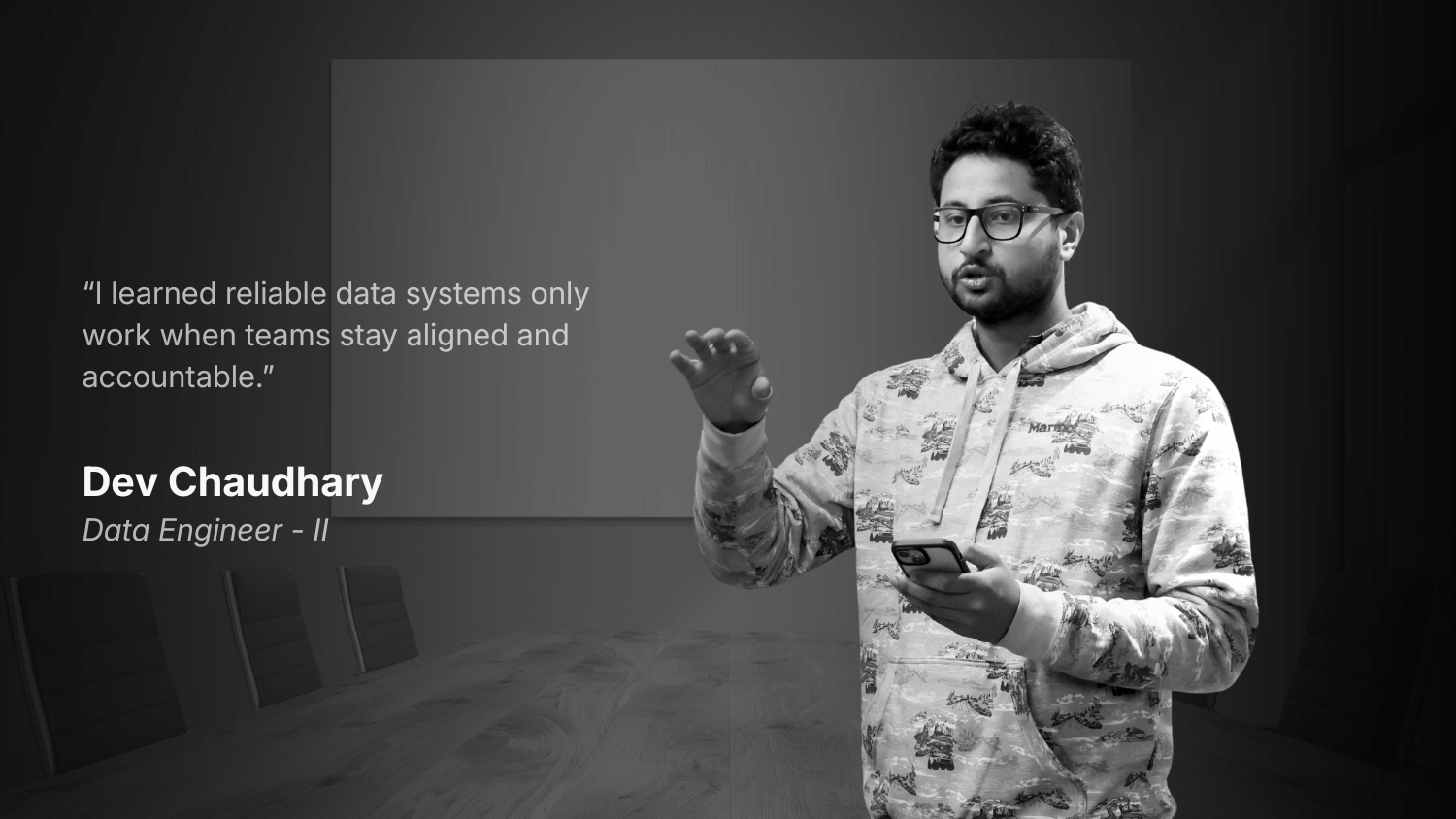
I spent years believing the path to becoming a great data scientist was simple: learn more algorithms, build more complex models, chase higher accuracy. It made sense on paper. It did not work in practice. The more I worked on real problems with real stakeholders, messy data and business outcomes on the line, the more I realised everything I thought defined excellence in this field was only part of the picture.
The most valuable data scientists pair technical depth with business judgment and clear communication. Accuracy on test data does not guarantee a working real-world solution, cross-functional teams need a shared problem definition more than more meetings, and the next era will reward system design, data quality and trustworthiness over model complexity. Real impact comes from understanding problems deeply.
The most common myth is that the best data scientist is the one who knows the most advanced models. It is an understandable belief because the field rewards technical depth, interviews test it and conferences celebrate it. The people who actually create consistent, meaningful impact in organisations are the ones who understand the business deeply, ask the right questions before writing a single line of code, communicate findings clearly to non-technical stakeholders and translate messy real-world problems into deployable solutions.
Technical skill matters, but it is the entry ticket, not the winning hand. The data scientists who move the needle pair that technical ability with business judgment and strong communication. That combination is far rarer and far more valuable than algorithmic expertise alone, and it is the lens through which I now evaluate every project I take on.
In September 2024, I took part in a Global Nodes hackathon believing that if my model achieved the highest accuracy, the solution wins. That experience dismantled the belief entirely. My model performed well on training and test data, but I had optimised for a metric without fully understanding the actual business use case. A model can perform exceptionally on benchmark data and still fail when deployed on real-world inputs, especially if the right questions were never asked at the start.
Data science is not a metric-improvement exercise. It is a problem-solving discipline, and the problems are rarely as clean as the datasets we train on. My process now starts with asking the right questions upfront, understanding business context and constraints, validating assumptions before they become embedded in model design and thinking about how the solution will behave in production over time, not just on evaluation data.
People usually attribute great teamwork to smart individuals, clearly defined roles or strong communication. Those things matter, but the subtler reason cross-functional teams underperform is that different people are solving different versions of the same problem without realising it. Business teams focus on impact and timelines, engineers on scalability, data teams on model performance and product teams on user experience. Each group is doing their job well, yet they produce friction instead of progress.
The ingredient most people overlook is not communication. It is a shared definition of the problem. When everyone is aligned on what is actually being solved and what success means for the organisation, collaboration becomes dramatically easier. When it is missing, even the best-run meetings do not fully close the gap.
The shift already underway will define the next two to three years: data science and AI are moving from being model-centric to system and decision-centric. The question that is taking over is how we build reliable AI systems that actually work in real-world environments. Data quality will matter more than model complexity as foundation models become widely accessible and organisations compete on proprietary data, domain understanding and workflow integration.
AI orchestration and system design will become core skills. The future is not a single model producing a single output, it is interconnected systems with multiple models, tools and agents working in coordination. Evaluation and trustworthiness will move to the centre as organisations discover that deploying AI is far easier than making it reliable. Hallucinations, bias, drift, security vulnerabilities and inadequate monitoring are already major pain points.
<checklist>
</checklist>
Don't confuse being technically strong with being truly valuable. The most technically impressive solution that nobody understands, trusts or uses creates no value at all. The simpler solution that solves the right problem, communicates clearly and fits into how people actually work is the one that changes things. It took me longer than I would like to admit to learn that lesson. I hope it takes you less.
Have a project in mind? We'd love to hear about it. Tell us what you're building and let's explore what's possible.
hello@globalnodes.com
+91 9873388887