Blog
Chunking Strategies for LLM Applications

July 23, 2026

time
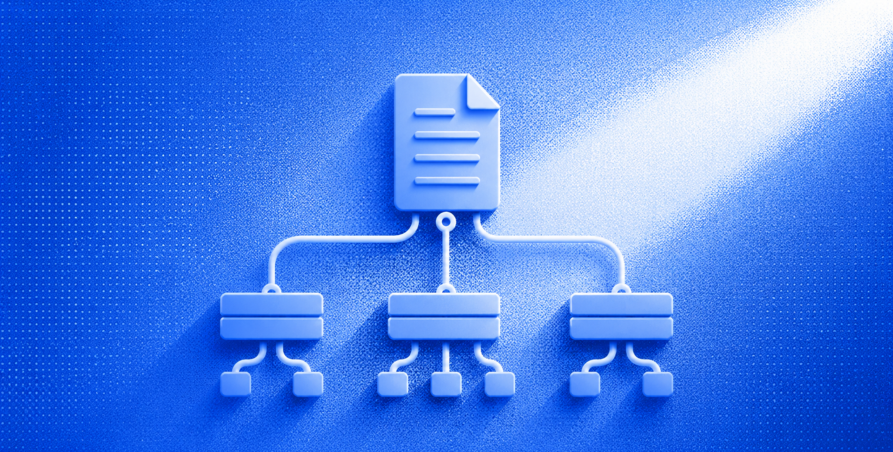
Large Language Models (LLMs) are only as effective as the information they receive. Whether you're building an AI chatbot, enterprise search system, or Retrieval-Augmented Generation (RAG) application, the quality of document chunking directly impacts the accuracy of responses. Choosing the right chunking strategy for LLM applications ensures that your AI retrieves the most relevant context without overwhelming the model.
In this guide, we'll explore what LLM chunking is, common chunking methods, and when to use semantic chunking for better AI performance.
Chunking is the process of breaking large documents into smaller, manageable sections called chunks before storing them in a vector database or retrieval system.
Since LLMs have context window limits, they cannot process entire books, manuals, or knowledge bases at once. Chunking allows the AI to retrieve only the most relevant portions of information for a user's query.
For example, instead of embedding a 100-page policy document as one block, the document is divided into meaningful sections that can be searched independently.
A good chunking strategy improves:
Poor chunking, on the other hand, can lead to incomplete answers, missing context, and hallucinations.
This method splits documents into chunks of a predefined number of words, sentences, or tokens.
Advantages:
Limitations:
Best for:
Recursive chunking attempts to preserve document structure by splitting text using headings, paragraphs, and sentences before falling back to smaller units if necessary.
Advantages:
Best for:
Semantic chunking groups content based on meaning rather than size. AI or embedding models identify topic boundaries and create chunks that keep related ideas together.
For example, instead of splitting every 500 words, semantic chunking keeps an entire section discussing authentication, billing, or compliance in one chunk.
Advantages:
Best for:
Each chunk consists of one or more complete sentences.
This approach prevents sentences from being cut off and works well for conversational datasets.
This strategy follows the document's natural hierarchy, using headings, chapters, tables, and sections as chunk boundaries.
It is particularly useful for manuals, contracts, and technical documentation where structure carries meaning.
Many RAG systems include chunk overlap, where a small portion of one chunk is repeated in the next.
For example:
Overlap helps preserve context across boundaries and reduces the chance of missing important information that spans multiple sections.
However, excessive overlap increases storage requirements and retrieval costs, so it should be used carefully.
There is no universal chunk size. The ideal length depends on the application and document type.
General recommendations:
Use CaseSuggested Chunk SizeFAQs100–300 tokensBlog articles300–600 tokensTechnical documentation500–800 tokensResearch papers700–1,000 tokensLegal and healthcare documentsSemantic or structure-based chunks
The goal is to balance context preservation with retrieval precision.
To improve retrieval quality:
These practices help ensure that the right information is retrieved when users ask questions.
Effective chunking is essential for:
In each case, well-structured chunks improve response accuracy and reduce irrelevant results.
Chunking is one of the most important design decisions in any Retrieval-Augmented Generation (RAG) or LLM-powered application. While simple fixed-size chunks work for basic use cases, semantic chunking and structure-aware approaches provide significantly better results for enterprise systems.
By selecting the right chunking strategy for LLM applications, organizations can improve retrieval quality, reduce hallucinations, and build AI systems that deliver faster, more accurate, and context-aware responses.
Have a project in mind? We'd love to hear about it. Tell us what you're building and let's explore what's possible.
hello@globalnodes.com
+91 9873388887